
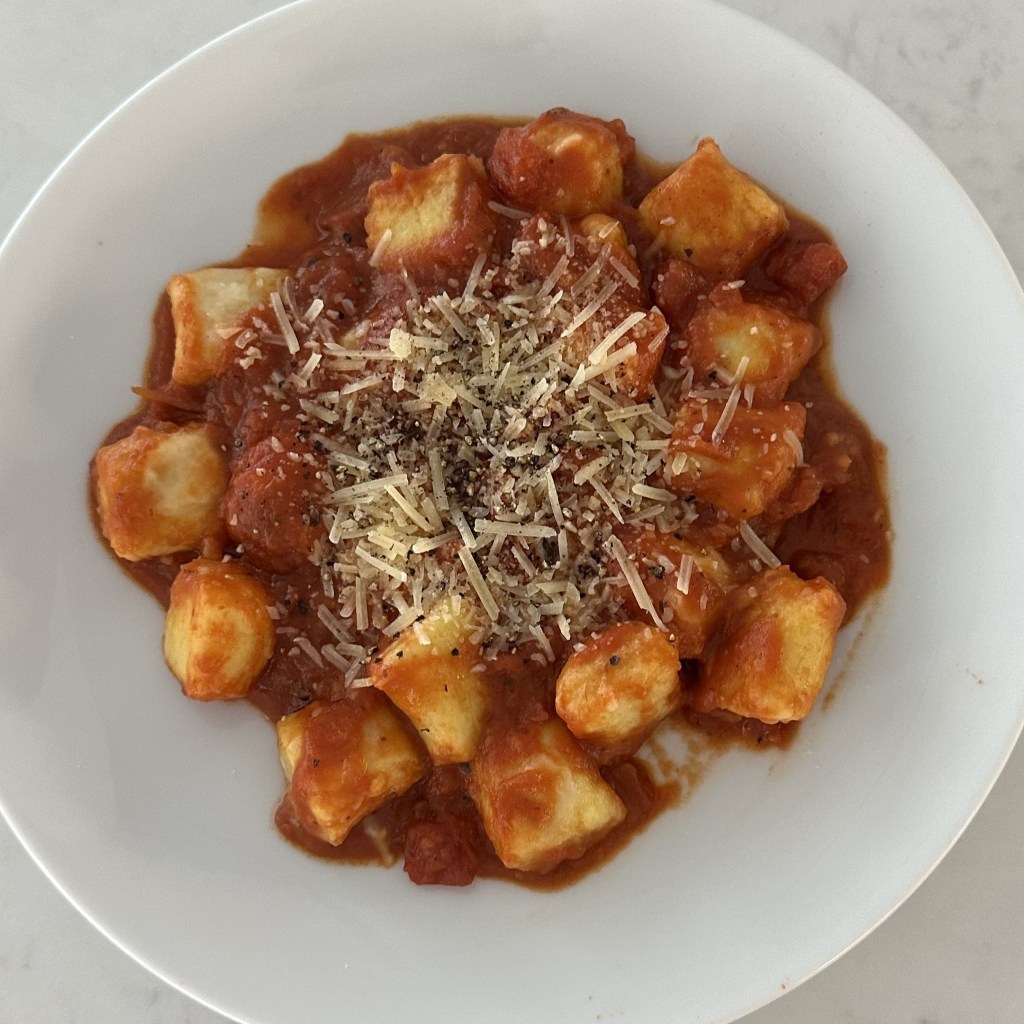
When it comes to Italian dishes, gnocchi rides near the top as a favorite. The other evening, dining with my daughter at Enoteca Italia, gnocchi was a daily special – well, not just any gnocchi, but gnocchi in a Bolognese sauce with a melt-in-your-mouth short rib – and trying it was a no brainer.
I have a couple of gnocchi recipes, one of which I’ve already posted. Both are good, and both make for a tasty dish. But what stood out most to us at Enoteca Italia was the absolute pillow softness of their gnocchi. By comparison, theirs made mine, and my daughter’s, more akin to hockey pucks. I needed to find a way to replicate that pillowy texture, and as fate would have it, along came Matthew Ryle. Here’s what he posted. Take a look. I’ll share his recipe with you, verbatim, talk bout how it’s made, and what I learned and the difference it made for me and my gnocchi.
INGREDIENTS
700g Mash (cooked/passed )
100g “00” Flour
10g Cornflour
2 Egg yolks (Burford brown, Clarence Court)
Salt+pepper
DIRECTIONS
To make Mash, place 6 medium sized potatoes in a baking tray with salt and bake at 200C for 1 hour or until soft. (see NOTE 1) Cut the potato in half whist still piping hot and push through a sieve. (see NOTE 2)
Allow the potatoes to cool then gently mix all ingredients together by hand, being careful not to over work. (see NOTE 3) Adding “00” flour where necessary – dough wants to be quite dry.
Place Gnocchi dough in a piping bag, cut the end to desired size and pip long tubes of gnocchi on to the floured chopping board. Cut and give the desired shape. (see NOTE 4)
Bring a large pan of salted water to the boil, place gnocchi in the water and cook until they float to the top.
Pictured above, I served the prepared gnocchi with a store-bought Marinara sauce, and it was good, However, I’m not going to miss an opportunity to re-share with you the Herbed Parmesan Sauce that I learned at a gnocchi class at The Chopping Block. Mild, and very flavorful, it doesn’t hide the gnocchi, but goes hand in hand with it. Enjoy!!!
NOTE 1
Maybe I’m just now noticing, but more and more I’m seeing potatoes baked on a bed of coarse salt. Apparently, this pulls some moisture from the potatoes as they bake, giving you a fluffier potato. I’m not exact on the science, but I can speak for the outcome. It works!!!
NOTE 2
If you happen to have a potato ricer, that will do. If not, a strainer works quite well (that’s what ( used),, but I don’t recommend a very fine mesh. You’ll never get it through.
NOTE 3
You knead bread dough to encourage the development of gluten. And no doubt you’ve read recipes that caution against over-kneading to avoid the toughness of too much gluten development (think of seeing that caution in pie crust and biscuit recipes). The technique I picked up in Matthew Ryle’s Instagram post was using a bench scraper to cut in all of the ingredients, with no real kneading in the traditional sense. I put the Mash on a cutting board, sprinkled on the flour, corn flour (corn starch, but I used potato flour/starch), and salt and pepper, then used my bench scraper to cut it all in; then I added the egg and mixed it, not by kneading, but by folding it in with the bench scraper. The texture of the resulting dough is a true indicator of the pillowy gnocchi you’re going to get.
NOTE 4
Despite how the dough looks, it is soft and pliable enough for you to pipe and cut it. Most recipes I have seen call for some kneading of the dough, cutting it into manageable pieces, then rolling it into a thick rope, which you then cut to size. I’m not saying that’s wrong, but the rolling is another form of kneading, and too much is going to toughen up the gnocchi.


 never 2 old 2 start cooking
Leave a reply to mary dell putman Cancel reply