
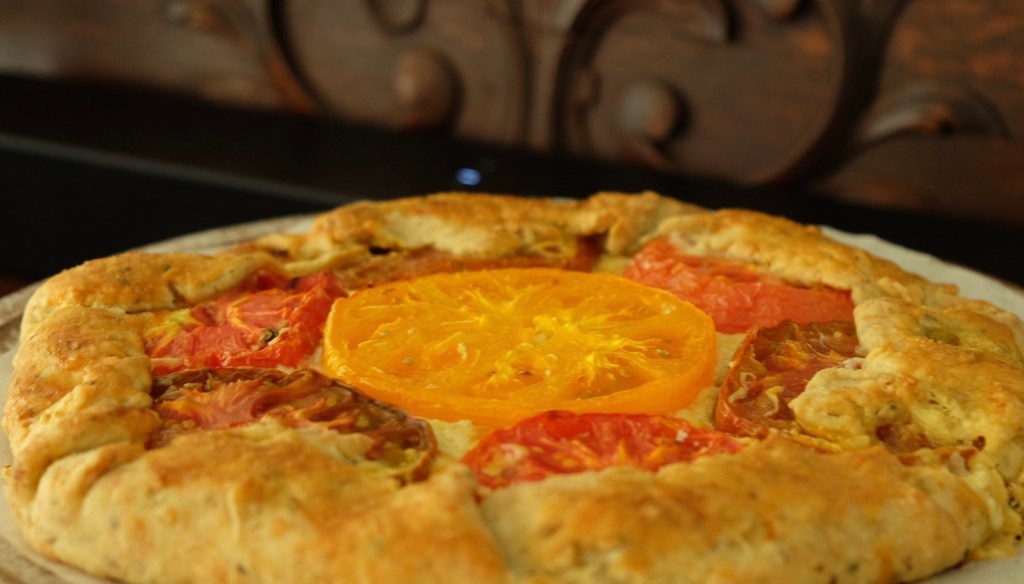
Or how you say galette in Italian.!
If you’ve followed along for any time, you’ll know that a galette is one of my favorite things to make. Quick, easy, and incredibly versatile. Enter the crostata, the Italian equivalent (and from what I’ve read, the French actually did this one first). No difference in the preparation or baking, that is until I ran across a recipe by a guy who lives and shares his life on the family farm in Iowa. Meet Kaleb Wyse.
Kaleb had an Instagram video tutorial for a heirloom tomato crostata, including making the crust from scratch. Ramping up the typical crust of flour, butter, maybe some sugar, and water, the addition of Parmesan cheese and an Italian herb blend to the dough made calling it a crostata too easy.
Here’s the recipe. Enjoy, enjoy, enjoy!!!
Heirloom Tomato Crostata (Galette)
INGREDIENTS
For the dough
1-1/2 cups all-purpose flour
1/2 tsp kosher salt
1 tsp white granulated sugar
2 tsp dried Italian seasoning
1/2 cup grated Paremsan cheese
10 tbsp unsalted butter, cubed
For the crostata (galette)
2 to 2-1/2 lbs tomatoes (heirlooms will give you more color and size options, but any good, flavorful tomato will work)
Kosher salt
6 oz cream cheese, softened
2 tsp Dijon mustard
6 oz Gruyere cheese, shredded
8 leaves fresh basil
For the egg wash (optional)
1 egg
2 tsp water
INSTRUCTIONS
Prepare the dough:
In a large bowl, combine the flour, salt, sugar, Italian seasoning, and Parmesan cheese. Mix together. Add the cubed butter and toss with the dry mixture to coat all of the pieces of butter. Work the butter into the flour until the pieces of butter are no larger than the size of a pea and the mixture resembles wet sand. (see NOTES) Add 4 tbsp of cold water and toss to combine. (see NOTES) If the dough is crumbly and not easily pressed into a cohesive disk, add more water as needed until the dough presses together and forms a disk. Wrap in plastic wrap and refrigerate for 30 minutes.
Prepare the tomatoes.
Remove the cores and slice the tomatoes into ½-inch slices. Lay the tomatoes on paper towels and sprinkle them with kosher salt to remove excess moisture. Let the tomatoes sit for about 20 minutes while the dough chills.
Preheat the oven to 425 deg.
Mix together the filling.
In a small bowl, mix the cream cheese until it is soft and creamy. Add the Dijon mustard and Gruyère cheese. Mix together until combined.
Form the galette.
On a lightly floured surface, roll the pastry dough into a 14-inch circle. Spread the cream cheese filling on the rolled-out dough, leaving a 2-inch border around the edge. (see NOTES) Sprinkle on the basil leaves. Pat the tomatoes with the paper towels to remove any excess liquid. Lay slices of tomato on top of the cream cheese filling, reserving the 2-inch border. The tomatoes can overlap slightly but should be in a single layer. Fold the edges of the dough, making 6-8 creases. For a shiny crust, whisk one egg with 2 tsp water and brush over the dough.
Bake the crostata.
Place the crostata in the preheated 425°F oven on the lower-third rack. Immediately turn the oven to 375°F. Bake until the crust is golden on top and bottom, 35-40 minutes. Once baked, remove from the oven and cool for 10 minutes before slicing and serving. Top with torn pieces of fresh basil. (see NOTES)
NOTES
I don’t think I’m alone in viewing pie crust as a challenge; it’s one of baking’s more intimidating tasks. However, when the tutorial put it in the context of being like riding a bicycle (“once you do it, you never forget how”), I made myself do it, and was surprised that it turned out as well as it did. Did I learn something? Of course.
First of all, I think I’ll feel more comfortable, next time, breaking up the cold butter with a pastry cutter rather than by squeezing it between thumbs and forefingers. I think I’ll get the consistency I need quicker, more uniformly, and with less chance of getting the butter too warm. I’ve not used a food processor for this, but a lot of folks say that works just as well, and it is quick.
Where the recipe calls for cold water, I followed the tutorial, and made up some ice water so that the water was substantially colder than just from the cold water tap in your kitchen. Do I think it mattered? Yes, I do.
The softer the cream cheese and Gruyere mixture, the better. You don’t want to tear the dough when spreading the cheese mixture. Place spoonfuls of the cheese mixture on the dough (observing the border) and then spread. It’s easier.
This crostata is great as a side. It’s also great as an entree, especially when accompanied by a salad of mixed greens with a tangy vinaigrette. Firmly believing there’s no such thing as too much of a good thing, I topped mine with some balsamic glaze and a sprinkling of Feta cheese. The dryness and texture of the Feta really complement the sweetness of the tomatoes, and the creaminess of the cheese layer.

BUONO APPETITO!!!


Leave a Reply