
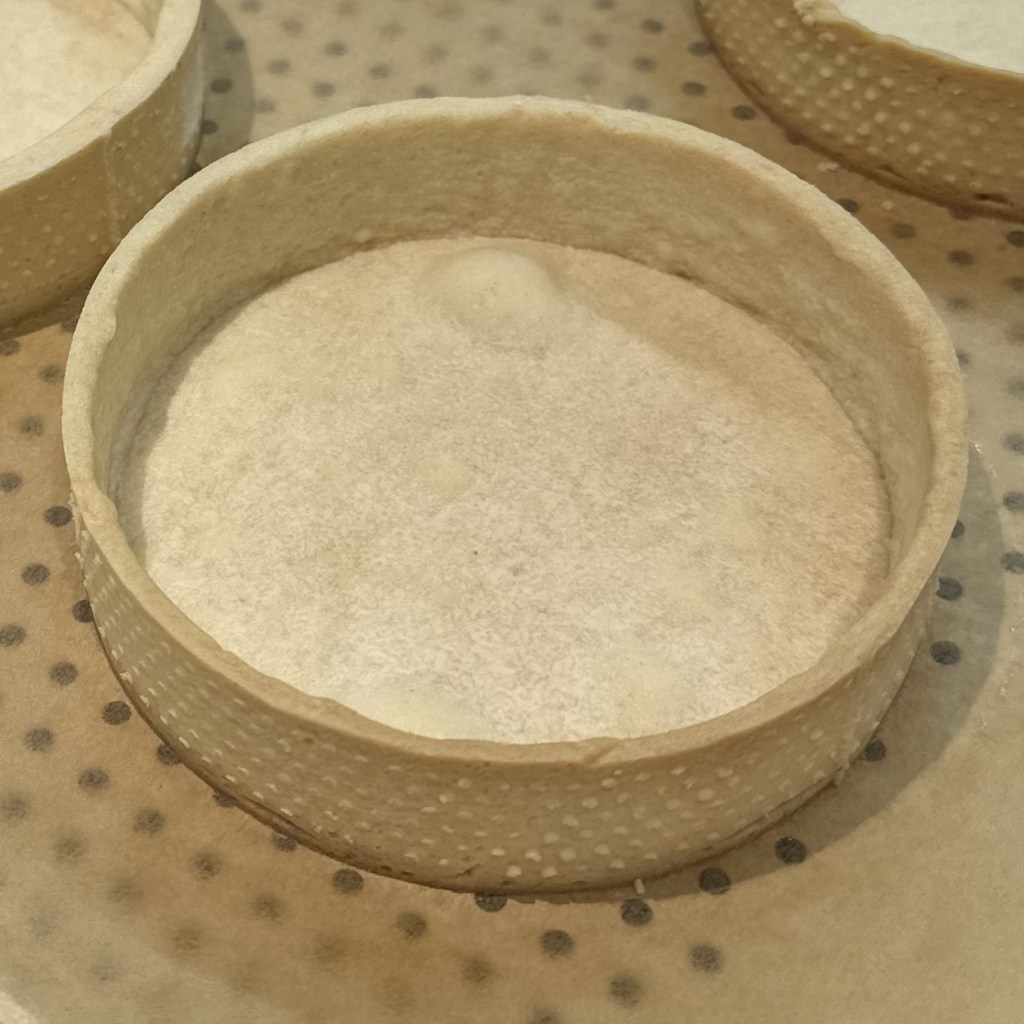
Tart pans come in many sizes, most with fluted sides, and with removable bottoms (so you can take the tart out and display it in all its splendor). My fascination, and subsequent infatuation with tarts, veered toward the smaller size – tartlets, if you will – that were round, with perfectly vertical sides. Just right for pastry shop displays and for sharing with one or two other people (if you’re feeling generous). This recipe comes from Jules Waringa, and trust me, it took a lot of looking to find it. For me, it gives the perfect combination of look, color, and crunch – the egg and cream wash is a game changer. And I like the sparseness of the recipe and instructions, encouraging the development of your own skills and intuition. Need an alternative approach? Look here.
Getting enough shells for what you want to do does take time, principally because the dough gets soft rather quickly because of the butter content. Before you start, make some space in your fridge or freezer for a half sheet pan. You’ll be glad you did, as you’ll want to keep chilling the dough to make it easier to work with.
Tart rings are what give the classic round, vertical-sided look; I ended up getting them in 4″ and 2″ diameters. A perforated sheet pan helps, too. And if you haven’t before, get a kitchen scale.
Let’s go.
INGREDIENTS
180 grams all-purpose flour, sifted (see NOTES)
80 grams icing (confectioner’s) sugar
30 grams almond powder (flour)
4 grams salt
30 grams whole egg (see NOTES)
110 grams butter (see NOTES)
20 grams egg yolk (see NOTES)
20 grams cream (see NOTES)
INSTRUCTIONS
Transfer the flour to your worktop or cutting board and use the bowl to make a well in the middle. Fill it with the icing sugar, the almond powder, the salt, the whole egg and the butter.
Now mix it well and then knead it till it’s a nice dough.
Then place it in a bowl and cover it with foil (or plastic wrap). Let it rest in your fridge for an hour.
Now dust some flour on your worktop and roll out the dough till it’s around 2 to 3 millimeters (1/8 inch) thin. Then cut half with a baking ring and place the dough circles in the middle of the rings. (see NOTES) Cut the remaining dough in long thin lines and gently place them on the inside of the baking rings. Keep the dough as cold as possible so it doesn’t break when forming it.
Then use a pallet knife or the back of a knife to remove any excess dough. Use a fork to make small holes at the bottom of the tart shell. This prevents the dough from raising up as it bakes.
After that bake them at 170 degrees Celsius (340°F) for around 15 minutes. Remove from the oven.
Then mix the egg yolk with the cream and use a brush to add a thin layer on both the inside and outside of the tartelettes. Now bake them for another 15 minutes till golden brown. After that let them cool down completely.
They can be used as soon as cooled; or you can store them for a couple of days in a sealed plastic bag.
NOTES
This recipe calls for all-purpose flour, and I strongly recommend that. I tried recipes that called for cake flour, but with a lower percentage of protein (gluten), cake flour gives a dough that is decidedly more difficult to manage.
A large or jumbo egg is usually 45-60 grams. To get 30 grams, I recommend taking an egg, beating it until no white is visible, then measuring it on a scale for the 30 grams.
A stick of butter is 113 grams, so start with a full stick and shave a small bit off. Then weigh it.
The recipe calls for egg yolk and cream in equal measure. Rather than trying to hit an exact 60 grams of an egg and cream mixture, separate an egg, and weigh the yolk in a small bowl; then add an equal weight of cream. You should have enough to accomplish the wash.
 never 2 old 2 start cooking