
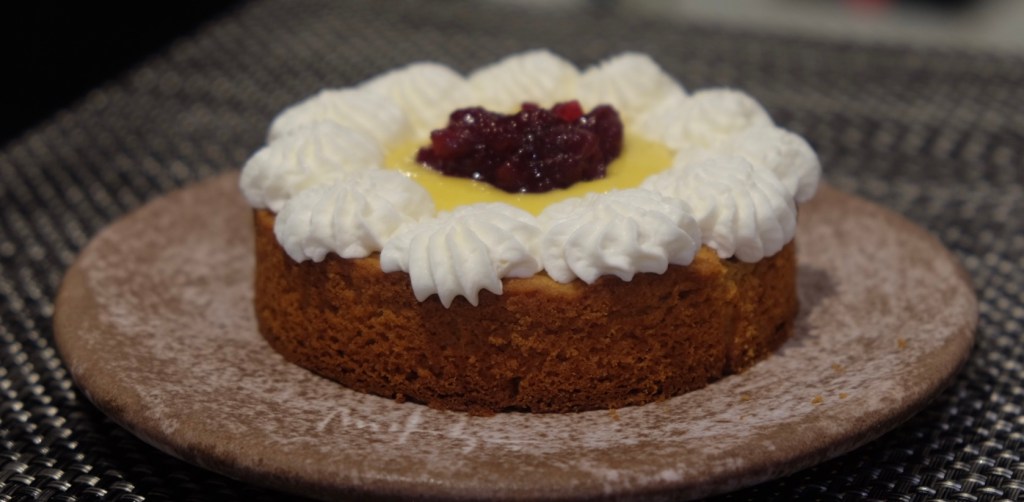
Shortbread is a pastry typically made with just three ingredients – butter, sugar, and flour. Sablé, which is most typically used for tarts (or tart shells), takes shortbread and adds egg to the mix. Sablé Breton is a French cookie, made with sablé dough . That being said, Sablé Breton lends itself to applications more like small cakes. That’s where I ended up, as the pictured Sablé Breton is slightly thicker than 1″. The addition of baking powder helps with the rising, so that even at the pictured thickness, it does not lose the traditional sandy texture, and cuts as a layer cake would cut. Once you’ve got the base, you can let your tastebuds and imagination run wild with possibilities. As shown, the pastry base is topped with an Orange Cremeux, Grand Marnier whipped cream, and fresh cranberry sauce. Let’s start with the base-ics!
INGREDIENTS
6 egg yolks
200g of granulated sugar (or caster sugar, which I find dissolves quicker)
300g butter, at room temperature, and cut into pieces
2 tsp vanilla extract
400g all-purpose flour
pinch of salt
4 tsp baking powder
DIRECTIONS
Separate the egg yolks, putting the whites aside for meringues, or omelettes, or seven-minute frosting, etc.
Using a stand mixer, or a hand mixer and a large bowl, combine the egg yolks and sugar, mixing until the sugar has dissolved and the mixture is foamy and very light in color.
Add the soft butter and the vanilla extract, then mix well to obtain a smooth paste.
Add the flour, salt, and baking powder, stirring until fully combined. The dough will be very homogeneous, and will feel quite light for its volume.
Transfer the dough to another bowl, cover it, and refrigerate for a minimum of 2 hours. Alternatively, place the dough on a sheet of plastic wrap, form it into a puck, fully wrap it, and put that in the fridge.
Toward the end of refrigeration time, preheat your oven to 350°.
Roll the dough to your desired thickness. The dough is best baked in a cake ring or a springform pan. You want to prohibit the dough from spreading as it bakes.
Depending on thickness, bake for 13-20 minutes, until golden brown.
Once baked, let the Sablé Breton cool on a baking rack.
NOTES
I’m fortunate enough to have both a 9″ springform pan (pictured to the right), and a set of 4.5″ springform pans (which is what I used for the Sablé Breton pictured above). Cake rings are usually made of stainless steel, and can be purchased individually or as a set of graduated sizes.

In the lexicon of cooking, particularly when looking for toppings or garnishes, you may see the term “Chantilly Cream”. Chantilly Cream is a fancy name for whipped cream with sugar added. Powdered sugar works best, as the cornstarch in most store-bought powdered sugar adds some stability. If you want the cream to really hold its shape, add a bit of Mascarpone to the mix. My go-to for Chantilly Cream is 1 cup very cold heavy (whipping) cream with 1/4 cup powdered sugar. If you’re adding Mascarpone, a heaping tablespoon will be enough.
When incorporating Orange Cremeux in the finished production, I added a tablespoon of Grand Marnier to the Chantilly Cream for a bit of oompf.
 never 2 old 2 start cooking